
Hearing a drone through a moving vehicle
GW-VNR1 is a passive, AI-powered, vehicle-mounted early-warning system being built for FPV drones, including fibre-optic threats that can leave conventional RF detectors with nothing to detect.
The previous post worked out why detection range is the wrong number to optimise. That leaves a harder question: how do you hear a drone from a vehicle that is producing far more noise than the drone is?
The reason we are interested in sound at all is that a fibre-optic FPV can remove the radio link many counter-drone systems rely on. There may be no useful RF signal to detect and nothing to jam. The drone still has motors, propellers and moving air, so it still makes sound.
The naive version of acoustic detection follows from that: put a microphone on the vehicle, listen for a buzz, and alert when the sound gets loud enough. That version falls apart almost immediately, and the reason it falls apart shapes most of how GW-VNR1, the Acoustic Early Warning Set, has to work.
A drone is not a sound
It is a structure. Anything with a rotating blade produces a family of related frequencies: a fundamental set by the rate at which blades pass a fixed point, with harmonics above it. A three-blade propeller turning at 20,000 RPM puts that fundamental near 1 kHz, and the rest of the family sits above it.
The useful part is not that those frequencies exist. It is that they move together. When a drone changes throttle its whole signature shifts, because the frequencies are produced by the same rotating system. On a multirotor several motors do this at once, each at a slightly different speed as the aircraft changes attitude and load. That evolving structure carries far more information than volume does.
Loudness on its own is unreliable. It changes with the aircraft, the propeller, the throttle setting, wind, terrain, reflections and orientation, and two identical drones at the same distance can sound very different. So the useful question is not whether something is loud. It is whether the sound behaves like the kind of rotating system we are looking for.
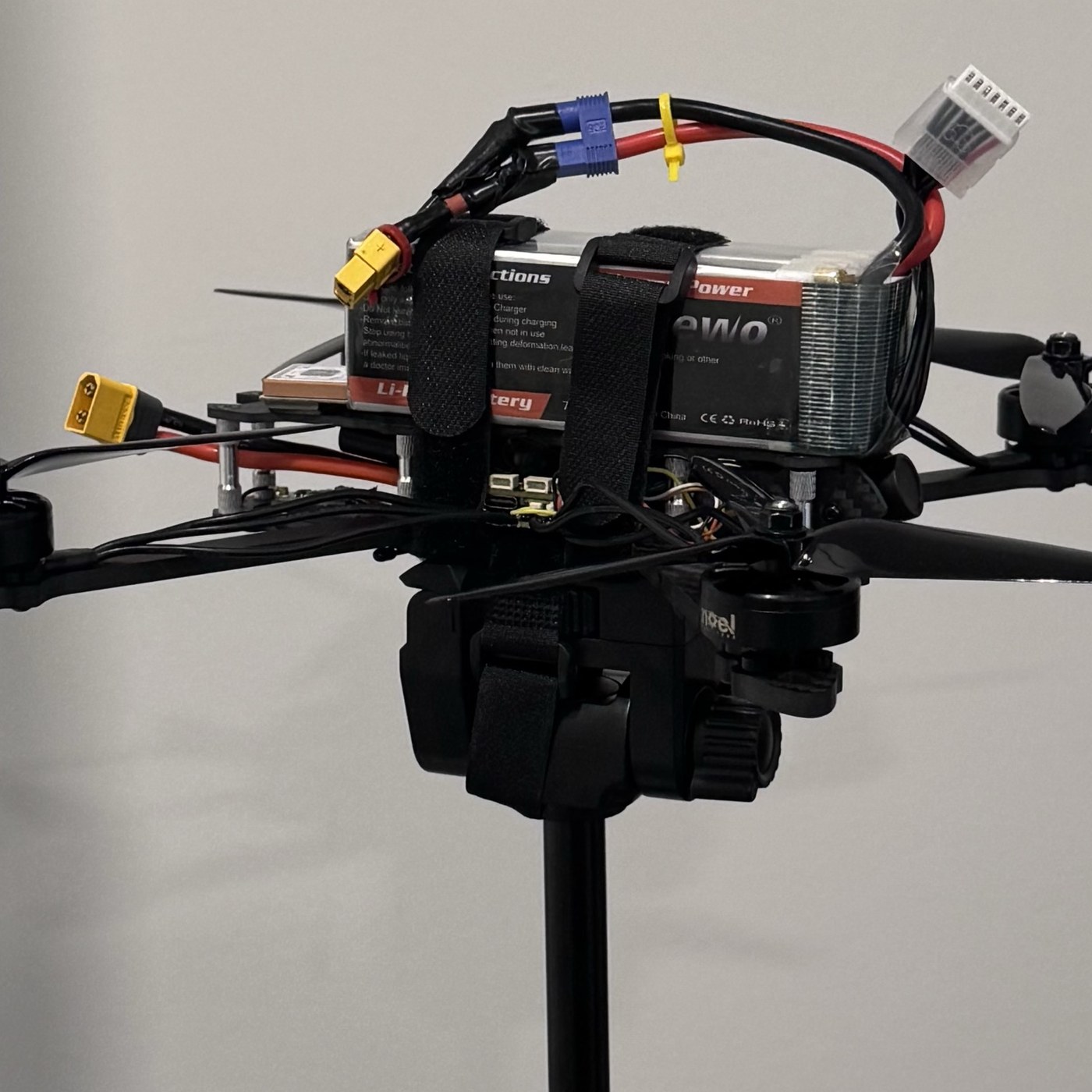
The world is full of things that make noise
Drones are not the only things around a vehicle. Wind, tires, road noise, engines, generators, compressors, aircraft and other vehicles all put energy into the same microphones, and some of those sources are easier to separate than others.
Wind moving over a vehicle produces broad, disorganised noise, and tire and road noise behave similarly. They can bury a weak signal, but they do not look like a small set of propellers turning in a coordinated way. That makes them a signal-to-noise problem rather than a classification one.
The engine is harder, because it is rotating machinery. It produces organised acoustic structure of its own and occupies some of the same frequency space. It is also the source we know most about, since it is attached to the same vehicle as the sensor and is present continuously rather than arriving from an unknown direction at an unknown time. That makes it a different problem from the rest of the list, not a solved one.
The difficult cases are the other machines that rotate. Generators, compressors, light aircraft, other drones. These are not artifacts of bad processing. They share real acoustic characteristics with the thing we are trying to find, and that is the actual classification problem: not hearing a drone, but separating it from a world full of things that also spin.
Direction comes from the same sound
Sound from one side of the vehicle does not reach every microphone at the same moment. Because the microphones sit at known positions relative to each other, those small timing differences can be used to estimate where the sound came from. The same data used to detect a target also produces a bearing.
That matters because an alert without direction is only half useful. Something may be approaching is information. Something may be approaching from there is something a crew can act on.
Direction finding has its own constraints. The physical spacing of the microphones limits which frequencies are useful for estimating arrival direction, reflections from the vehicle and surrounding terrain complicate the measurement, and a flat array is naturally better at estimating direction around the horizon than elevation above it. None of that makes bearing useless.
A fast bearing that is approximately right is worth more than a precise one that arrives too late.
Why the system is layered
GW-VNR1 does not ask one AI model to solve the whole problem at once. Detection, classification and direction are different jobs, and separating them lets each part of the system do what it does well.
The first requirement is speed: recognise that something worth attention may be present. The second is confidence: decide whether that signal is consistent with the threat we are looking for. Direction runs alongside both and gives the operator something usable before every uncertainty has been resolved.
Separating the tasks also matters because GW-VNR1 runs locally on the vehicle. Compute, electrical power and warning time are all limited, and the system cannot wait on a network connection to make a decision. The principle is the same one from the previous post: identify something interesting quickly, then spend more effort deciding exactly what it is.
The vehicle is the hard part
All of this would be easier in an open field.
GW-VNR1 is mounted to a moving vehicle, so the sensor travels with an engine, a transmission, tires, airflow over the enclosure, changing road surfaces and passing traffic. The background can change from one second to the next, and the thing we are trying to detect may contribute a small fraction of the total acoustic energy reaching the array.
Stationary acoustic systems avoid most of this by putting sensors in known locations and letting the environment around them stay comparatively stable. That is a valid architecture, and for protecting a fixed area it makes a great deal of sense. But it protects a place, and we want the warning to move with the people who need it.
That means accepting the harder constraint: the acoustic system has to work while the sensor is travelling through noise. For GW-VNR1 that is not an edge case. It is the problem the whole design is organised around.
Greywing Technologies is building GW-VNR1 and GW-VSR1, passive vehicle-mounted drone detection and early-warning systems. Get in touch.